Now that we are closing out the PREPARE study, we are excited to note all the ways we are getting our study results out, and point to some places you can read more about what we’ve found.
Over the past year, we’ve presented our data to many different audiences:
- 2024: Rubeck S, Watts J, Dolan SM, Riggan K, Rippel L, Vora N, Michie M. “Prenatal genetic information as preparation: Parents and clinicians reimagining benefits for families and future children.” Paper presentation. ELSIcon 2024 (6th ELSI Congress); New York, NY.
- 2024: Rubeck S, Counihan KP, Watts J, Riggan K, Allyse MA, Goldenberg A, Michie M. “Narrating a journey of preparation: Longitudinal interviews with parents who received prenatal and postnatal genetic information.” Paper presentation. American Society for Bioethics and Humanities Annual Meeting; St. Louis, MO.
- 2025: Michie M. “Preparing to parent a child with a genetic condition: What parents need and the roles that health care providers play.” Massachusetts General Hospital Clinical Genetics Grand Rounds (online).
- 2025: Skotko BG, Michie M. “Lived experiences of parents who have received a prenatal diagnosis of Down syndrome.” Paper presentation. Down Syndrome Education International 2025 Down Syndrome Research Forum (virtual conference).
- 2025: Michie M. “Prenatal preparation as an outcome of genetic testing: What parents need and the roles of healthcare providers and support organizations.” Down Syndrome Collaborative (online).
Among our most important findings were:
- The journey of prenatal preparation starts with prenatal screening, even when results aren’t confirmed with diagnostic tests before or after birth.
- Prenatal preparation includes:
- psychological preparation (adjusting to a new reality and emotional processing),
- social preparation (connecting with supportive resources, including condition-specific support groups and other families in similar situations), and
- practical preparation (using genetic and prognostic information to plan for delivery, birth, and other possibilities such as fetal/neonatal loss or adoption).
- Healthcare providers and support groups are both key resources for preparation, and communication/referrals between them can help parents feel supported.
- There are limits to preparation, especially in cases of life-limiting diagnosis, or when diagnosis or prognosis is uncertain.
- But most parents in our study moved, over time, from worrying about a genetic diagnosis to embracing parenting a whole child.
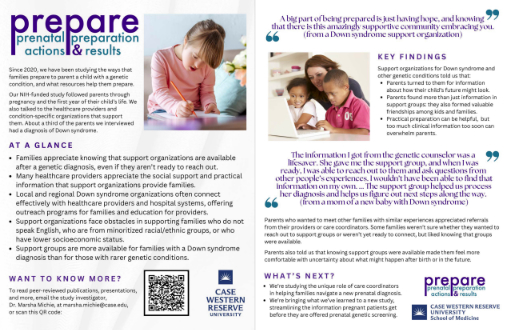
We distributed a flyer summarizing our findings relevant to Down syndrome support organizations at the Down Syndrome Affiliates in Action conference and other events in 2025. Click here to see a larger version.
For more information and links to all of our study publications, visit our page at the Prenatal Information Research Consortium!
 The PREPARE Study